My first reaction was that it felt like a threat. Then I looked again as a businessperson, and the picture became more interesting.
I came across Google's AI landing page patent not as a patent lawyer, but as a digital marketer and a business owner. My first honest reaction was simple: this feels like a threat.
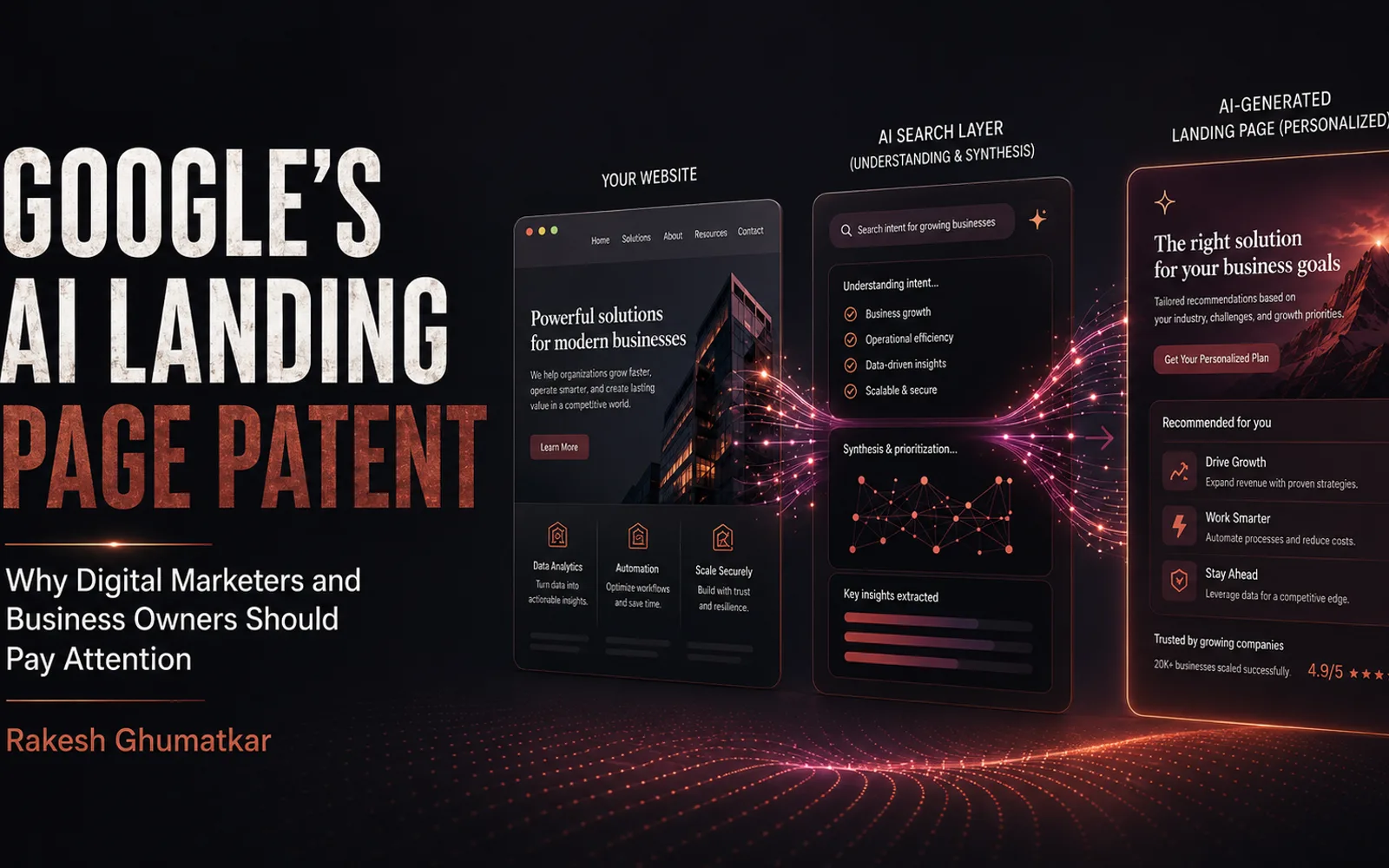
Here is the short version. In January 2026, the US Patent and Trademark Office granted Google patent US12536233B1, titled "AI-generated content page tailored to a specific user." It describes a system that can score a business landing page, read the user's search query and context, and then generate its own AI-built page for that specific user instead of sending them to yours. This article is for marketers, SEO professionals, web developers, and business owners who rely on Google for traffic, leads, and sales, and who want a clear, non-panicked read on what this patent does and how to prepare for it.
So is it dangerous? Partly. Is it also an opportunity? Also yes. The honest answer is both, and I want to walk through both sides rather than pick the easy emotional one.
Key takeaways
Google was granted a patent US12536233B1 on 27 January 2026. A granted patent is a legal right, not a launched product, so this is not live in Search today.
The system scores your landing page on signals like conversion rate, bounce rate, and click-through rate, and can then generate an AI-generated replacement page tailored to that user.
The patent's examples centre on e-commerce and paid shopping, not blogs or editorial content. For now.
The link to the AI page can sit inside a sponsored ad unit, which raises hard questions about who pays for the click and who controls the page the buyer actually sees.
The businesses most exposed are the ones with slow, weak, or unclear pages. Clean data, clear offers, and direct customer relationships are the real hedge.
What is Google's AI landing page patent?
Google's AI landing page patent, US12536233B1, is a system that evaluates a business landing page, scores how well it serves a user's query, and can generate an AI-built alternative page tailored to that user. It was granted by the USPTO on 27 January 2026 and assigned to Google LLC.
The full title is "AI-generated content page tailored to a specific user." The provisional application was filed in July 2024, and the granted patent carries 20 claims. You can read the primary document yourself on Google Patents.
In plain language, the AI-generated page is not a blank template with your logo on top. According to the patent, it can include a personalized headline, suggested filters and product clusters, a product feed, calls to action, sitelinks to product pages, and even an embedded AI chatbot. The page is assembled from your business data plus what Google knows about the user, such as their current query, previous searches, location, and preferences.
How the patent works, step by step
When you search, Google scores the page it would have sent you to. If that score crosses a threshold, the system can build an AI version of the page instead, then show a link to it in the results.
You search. Google receives your query and builds a normal search results page.
Google scores the landing page it would have ranked, using signals such as conversion rate, bounce rate, click-through rate, and what the patent calls page design or content quality.
If that score crosses a threshold, or the page is missing things like a product filter, the system can generate an AI version of the page.
The AI page is built from two sources: your site's data (products, text, images) and the user's profile (current query, past searches, location, preferences).
A navigation link to that AI page appears in the results. Under one of the patent's claims, that link can sit inside a sponsored content item, which is to say an ad unit.
That last point is the one I keep rereading. As reported by several search and advertising analysts, it implies a scenario where you bid on a keyword, win the auction, pay for the click, and the visitor lands on a page that Google built rather than one you control.
Is this a real feature, or just a patent?
It is a patent, not a product. Companies patent far more ideas than they ship. This one matters because of what it touches, not because it is live in Search right now.
I want to be precise here, because the difference matters. A patent is a legal right to an approach. It is not a roadmap and it is not an announcement. Google may never roll this out in the form described.
Worth knowing: the patent's examples point almost entirely at e-commerce, product feeds, and paid shopping ads. As commerce-focused coverage has noted, this is not currently described as a system that rewrites every blog or informational page on the web. The exposure today sits with retailers and shopping queries, not editorial sites.
That said, the direction of travel is already real. AI Overviews and zero-click search are not hypothetical. So the smart move is not to panic about the patent, but to read it as a signal of where Google's incentives point.
The open-web concern is real
Plenty of people in SEO, publishing, and web development will see this as a warning sign, and they are not wrong to. If Google can use your content, product data, and visibility to build its own page, then who really owns the customer journey?
You may still own the product. You may still fulfil the order and take the sale. But Google could own the first impression, the interface, the personalization layer, and the behaviour data before the purchase. The first impression is not a small thing. The way your brand shows up, the way your offer is explained, the way trust is built, all of that starts to move out of your hands.
The backdrop makes the worry sharper. Reporting from the Reuters Institute and Chartbeat found that Google search traffic to publishers fell by roughly a third in 2025, a study by Seer Interactive found organic click-through rates dropping sharply on queries where AI Overviews appear, and a large share of Google searches now end without a single click. Against that, an AI page that intercepts the buyer earlier is not hard to imagine.
The pragmatic business view
Here is the uncomfortable truth: customers do not care about your website as much as you do. Business owners care about brand control. Designers care about layout. SEO teams care about traffic. Customers care about usefulness.
They want the right product, a clear answer, an easy comparison, honest pricing, and an obvious next step. If an AI-generated page answers the exact question and removes friction, many people will simply prefer it. That is the part that makes this complicated. From the open-web side, it looks like Google taking control. From the conversion side, it looks like Google doing the expensive UX and personalization work that most small businesses never get around to.
A lot of businesses already run slow sites, weak landing pages, poor mobile experiences, and confusing navigation. If Google's AI can assemble a cleaner buying experience from the same data, some of those businesses might actually convert better. Not because the system is fair, but because their own page was the weak link.
What this means for digital marketers
For marketers, this is uncomfortable, because so much of the job has been built around improving websites, landing pages, content, and conversion paths. If AI systems start generating their own versions of those pages, some of that control shrinks.
But the work changes, it does not disappear. In the old model, we optimized pages for people and search engines. In the new model, we optimize businesses for people, search engines, AI systems, marketplaces, and platform-generated buying experiences. That means cleaner structured content, accurate product data, stronger service pages, clearer offers, better FAQs, real proof, and proper schema.
Marketers who only think in keywords, design, and traffic will struggle. Marketers who understand business, data, customer intent, offers, proof, and conversion systems become more valuable, not less.
Your website still matters, but its job changes
The wrong conclusion is that websites become useless. Your website still matters. Its role just shifts. It used to be mainly a storefront. Now it is also a structured information layer that search engines, AI systems, and marketplaces read to understand your business.
So your site now has two audiences. Humans need clarity, trust, good design, proof, and a simple path to buy. Machines need clean structured data, accurate product information, schema, current pricing, FAQs, and reviews they can parse without confusion. A beautiful site with messy data becomes a liability. A simple site with clean, accurate, structured data becomes a quiet advantage.
How to prepare before this becomes normal
You cannot opt out of where search is heading, but you can make your business the kind that AI systems represent accurately and that customers want to deal with directly.
If I were briefing a client tomorrow, this is the list I would hand them:
Clean up your product and service data so it is accurate, complete, and consistent across your site, your listings, and your profiles.
Add and validate structured data (Organization, Product, Article, Review) so machines understand exactly what you offer.
Write clear, self-contained answers on your pages. Put the answer first, not buried under three paragraphs of setup.
Fix the basics that trigger a low score: page speed, mobile experience, navigation, and an obvious next step.
Build owned audiences such as email, WhatsApp, and community, where no search layer sits between you and the customer.
Keep AI crawler access open in your robots.txt if you want to be cited in AI answers, and actually check that it is.
Track your visibility inside AI answers, not only your blue-link rankings, so you can see where you are being represented and where you are missing.
My takeaway
As a marketer, I first saw this as a threat, and to some degree it is. It threatens the old comfort zone where traffic flowed to a website and the website controlled the experience. As a business person, I see the other side too. If AI search and platform-generated pages keep spreading, our job is not to complain about them. It is to understand them early, prepare clients, and make sure businesses do not get left behind.
The businesses that win may not be the ones with the fanciest websites. They may be the ones with the clearest offers, the cleanest data, the strongest proof, the best product experience, and the most direct relationships with their customers. That is where digital marketing is heading. Not just traffic and design, but business clarity, data readiness, and customer ownership.
I would like to hear from marketers, SEO professionals, web developers, and founders who watch Google closely. Do you see Google's AI landing page patent as a serious threat to the open web, a practical conversion opportunity, or both?
Frequently asked questions
What is Google patent US12536233B1?
US12536233B1 is a Google patent titled "AI-generated content page tailored to a specific user," granted by the USPTO on 27 January 2026. It describes a system that scores a business landing page and can generate an AI-built alternative page personalized to the individual searcher.
Is Google already replacing websites with AI pages?
No. This is a granted patent, not a shipped feature. Patents protect an approach a company might use. There is no public confirmation that Google has launched AI landing page replacement in Search, and it may never roll it out exactly as described.
Does the patent affect blogs and informational sites?
Based on the patent's own examples, the focus is e-commerce, product feeds, and paid shopping. Commerce-focused analysts note it is not currently framed as a system that rewrites editorial or blog content. The clearest exposure today sits with retailers and shopping queries.
How does Google decide which pages to replace?
The patent describes a landing page score built from signals such as conversion rate, bounce rate, click-through rate, and page design or content quality. If the score crosses a set threshold, or the page is missing elements like a product filter, the system can generate an AI version.
Can a business opt out of Google's AI landing pages?
The patent does not describe an opt-out mechanism. It also notes the link to an AI page can appear inside a sponsored ad unit. Whether any real rollout would require advertiser consent is an open question that the patent does not answer.
What should marketers do to prepare?
Clean and structure your business data, add validated schema, write clear self-contained answers, fix speed and mobile issues, build owned audiences like email, keep AI crawler access open, and start tracking your visibility inside AI answers rather than only in ranking positions.
Does this mean SEO is dead?
No. The work changes rather than ending. Optimizing for people and search engines still matters, and a new layer is added: making your business easy for AI systems to understand and represent accurately. Marketers who grasp data, intent, and conversion become more valuable.