One thing I have learned over the years is that many businesses want business development, but very few understand how difficult business development actually is.
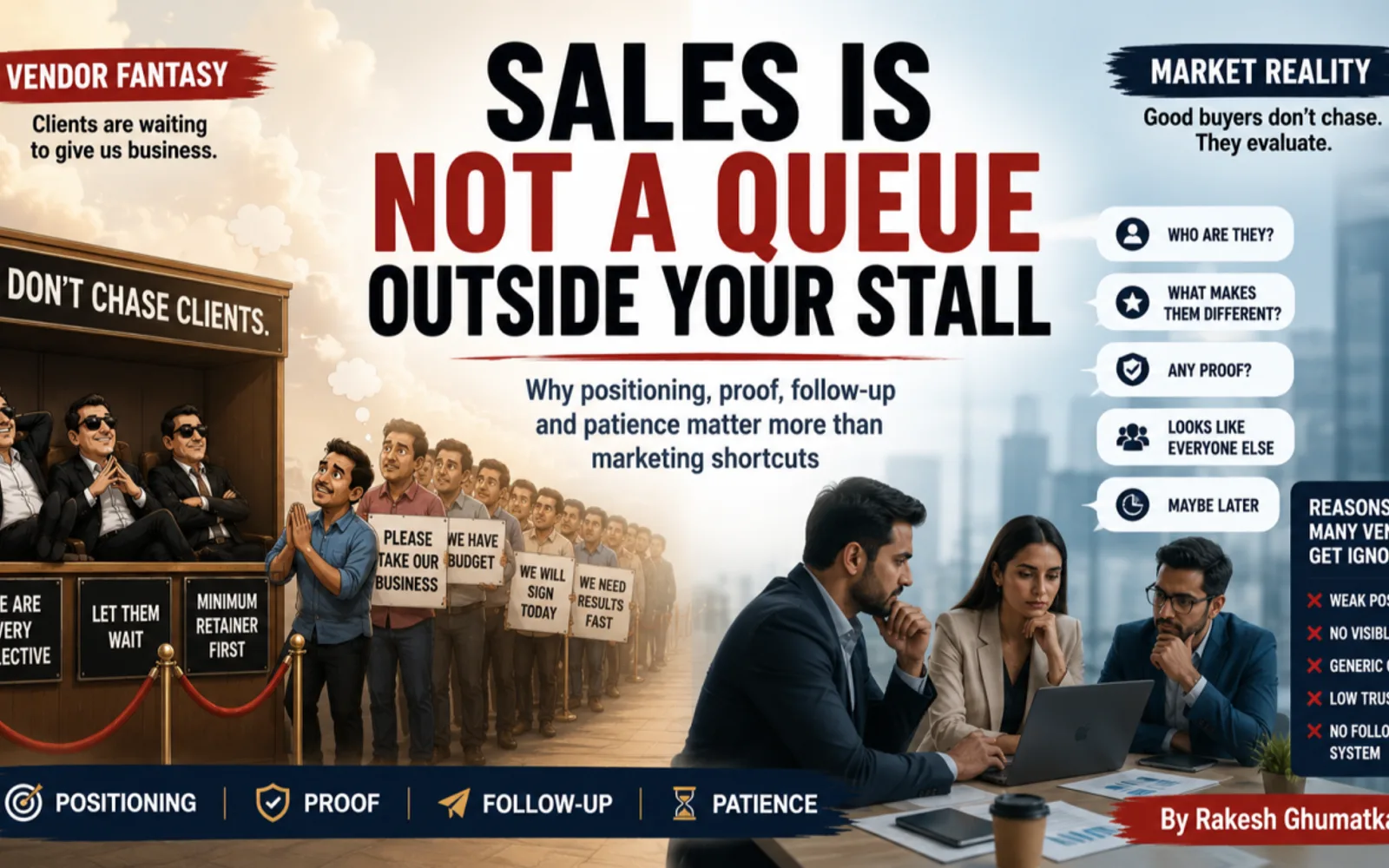
I recently created a satirical image showing vendors sitting comfortably while clients stood in a queue saying, “Please take our business,” “We have budget,” and “We are ready to sign.” It was meant as a joke. But like many jokes, it came from real business experience.

Buyers are not waiting outside our stalls. They are busy, distracted, comparing options, delaying decisions, and trying to reduce risk. That is how markets work.
What I See in Client Discussions
When I speak with small and medium businesses, founders, and sometimes CEOs about digital marketing, SEO, LinkedIn marketing, email outreach, and business development, I often hear similar expectations.
They want global clients. They want enquiries from the US, Europe, and other international markets. They want good content, good campaigns, and measurable results. That is fair. Every client should expect value for money.
But when I look at their website, LinkedIn profile, offer, proof, messaging, and positioning, I often feel the real issue is deeper. Sometimes the service is good, but the website does not explain it clearly.
Sometimes the founder has experience, but the proof is not visible. Sometimes the company wants global clients, but the positioning looks like every other vendor in the market. Sometimes I honestly feel, “Even I would struggle to buy from them.”
As a vendor, you cannot always say this bluntly in the first discussion. But marketing cannot permanently compensate for weak positioning, unclear messaging, weak proof, or lack of differentiation. If the offer looks ordinary, the market will treat it as ordinary.
Look at the world’s biggest brands. They are already known. They have trust, money, distribution, and customers. Still, they keep advertising. You see them in sports events, airports, conferences, television, digital ads, and sponsorships.
Why?
Because visibility fades. People forget. Competitors do not stop. Out of sight becomes out of mind. If billion-dollar brands continuously invest to stay visible, how can a smaller business expect a few posts, one campaign, or one month of outreach to create permanent market attention?
Marketing Tools Are Not Magic
The same misunderstanding appears across channels. On LinkedIn, many people think growth means hiring someone to write posts.
In SEO, some businesses expect rankings in a few weeks while competitors have been publishing content, improving pages, building authority, and earning trust for years.
In email outreach, many expect replies from strangers without strong positioning, relevance, timing, or follow-up.
In automation, many expect tools to do the thinking. But tools do not replace market readiness.A post can build credibility. SEO can create search visibility. Email can start conversations. Automation can improve consistency. But what happens after that? Does your website clearly explain why someone should trust you? Does your profile show proof? Is your message different from competitors? Are the right people seeing your content? Is there a system for outreach, conversations, follow-up, and tracking?
When one part is missing, results suffer.
What I Tell My Own Team
I see another version of this reality inside my own team. Sometimes team members get disappointed because prospects do not respond. They feel the outreach is not working. Sometimes they feel they are being judged because meetings are not getting booked immediately.
I tell them one thing. If sales were easy, every business would be successful.
If every email generated a reply, every company would have unlimited customers. If every LinkedIn connection request became a client, business development would not exist as a profession.
Sales is daily work. You improve the targeting. You improve the message. You follow up. You learn from responses. Some days nothing happens. Then one good conversation changes the month.
Hard work matters. Systems matter. Follow-up matters. But timing and luck also play a role. That is why patience is not laziness. Patience is part of the process.
Automation Is Not the Strategy
This is where I also want to say something that may not sound convenient for people selling automation. Automation for the sake of automation does not work.
Most prospects can sense when they are receiving an automated message. Even AI-personalised emails often look automated if nobody has applied judgement. We also receive such messages ourselves. Unless the offer is truly exceptional or the timing is perfect, we usually ignore them.
But when someone writes with real context, when the message feels relevant, when it looks like a person has actually understood us, we pay more attention. That does not mean automation is useless. Automation is useful for tracking, reminders, sequencing, research support, reporting, and consistency. AI is useful for drafting, improving structure, and saving time.
But someone still has to think. Someone has to edit. Someone has to decide whether the message makes sense for that person. The future is not blind automation. The future is a smart combination of AI, automation, and human judgement.
Use automation where it saves time. Use human effort where trust is required.
A Client Who Stayed Long Enough to See Results
One of our clients from India was targeting the traditional automotive industry in the United States. This was not a fast-moving software market. It was a conservative industry with established relationships and slower decision cycles.
The system took time to build. Targeting had to be refined. Messaging had to be improved. Follow-ups had to be tested. Processes had to mature. Results did not come in the first few weeks. They did not come in the first month either.
It took around three to four months before meaningful conversations and business opportunities started coming through. If the client had stopped after the first month and said, “This is not working,” the system would have died before it matured.

That experience again proved one thing. Business development is not about instant success. It is about consistent execution.
Why I Created the LinkedIn Growth System Ebook
After seeing the same challenges repeatedly, I started documenting a practical LinkedIn Growth System. It covers profile positioning, content strategy, ICP connection building, engagement, outreach, follow-up, automation support, and tracking.
The ebook is available here for free download for anyone who wants to use LinkedIn more systematically for visibility, credibility, and business development. If you find it useful, use it. If you need help implementing it, my team and I can help you build and run the system.
Download Linkedin Growth System Ebook
My point is simple. Sales is not a queue outside your stall. LinkedIn is not a magic machine. SEO is not an overnight shortcut. Email outreach is not a lottery ticket. Automation is not a substitute for thinking.

Business development is still built on proof, positioning, visibility, conversations, follow-up, and patience. The tools have changed. The fundamentals have not.