Introduction
A donor education and nonprofit resource platform wanted to improve its organic search visibility across a broad range of fundraising, donor education, planned giving, foundation, and nonprofit-related topics.
The website covered a wide range of content areas, including educational articles, planned-giving resources, foundation-related content, donor education materials, directories, and sector-focused editorial content. This gave the platform strong topical potential, but it also meant that SEO work needed to be organised carefully so that the right pages targeted the right search intent.
This case study focuses on the SEO performance documented from January to May 2026. The work was focused on improving search visibility for high-value informational and sector-focused terms, strengthening page-level keyword targeting, and building wider topical coverage across donor education, foundations, planned giving, legacy giving, nonprofit resources, and related search topics.
Background
The website featured a wide range of editorial articles, reference resources, planned-giving pages, foundation-related content, directories, and interactive tools. This created strong SEO potential, but it also meant that optimisation needed to be carefully organised at the page level.
The opportunity was to improve keyword coverage across core donor education, nonprofit, planned giving, and foundation-related terms, while moving more existing pages into stronger Google rankings.
A detailed keyword and URL-mapping process was used to identify primary and secondary keyword opportunities across high-priority pages, including the homepage, informational resource pages, planned-giving content, donor education videos, foundation resources, and directory content.
Objectives
The SEO work focused on the following objectives:
Improve organic search rankings: Increase visibility for relevant donor education, nonprofit, foundation, planned giving, and fundraising keywords.
Increase qualified organic traffic: Drive more users to informative resources, tools, and core content pages by improving Google rankings.
Expand keyword coverage: Grow the number of ranking keywords across Top 3, Top 10, Top 20, and Top 50 groups, while moving opportunity terms closer to page one.
Strengthen user engagement: Increase organic sessions, engaged sessions, and on-site activity from search users.
Improve AI and SERP-feature visibility: Increase visibility in Google AI Overviews and other answer-driven SERP features through better keyword targeting and helpful content coverage.
SEO Strategy
Keyword Research and Page-Level Mapping
A 53-page SEO URL inventory was prepared to map primary and secondary keywords, search volumes, current titles and meta descriptions, and recommended updates.
This helped create clearer page-level targeting across major content groups, including:
donor education and informational content
planned-giving and planned-gifts pages
estate-planning education
foundation resources and lists
educational video content
directory and nonprofit resource pages
The goal was to create a stronger keyword structure across high-priority pages while reducing overlap between closely related content.
Competitor and Search-Gap Research
Competitor keyword data was reviewed against data from other websites in the nonprofit, donor education, fundraising, and resource-platform spaces.
The research helped identify:
keyword themes already driving traffic to competing websites
topic areas where the platform could improve coverage
opportunities to strengthen existing pages
areas where new or improved content could support rankings more effectively
This competitor and gap analysis helped shape content priorities and keyword opportunities across resource pages, educational content, directories, and planned-giving topics.
On-Page Optimisation
Priority titles, meta descriptions, headings, and page copy were reviewed with a clearer primary keyword focus.
The goal was to improve relevance for search queries while also reducing unnecessary overlap between pages covering donor education, planned giving, foundations, and nonprofit resources.
This work helped strengthen the alignment between page content and search intent across high-priority sections of the site.
Content and Topical Coverage
SEO work also focused on leveraging the site’s existing editorial, resource, and guide content to enhance topical relevance.
Priority areas included:
donor education content
foundation lists and resources
planned gifts and legacy-giving topics
estate-planning education
fundraising resources
nonprofit technology and sector insights
educational resource content for donors and nonprofits
The goal was to strengthen both the depth and breadth of the platform’s topic coverage so that it could rank for a wider set of relevant searches.
Internal Linking and Content Support
Related resource pages, guides, articles, and directory content were used to support key topic hubs.
This created a clearer path for both search engines and users to discover relevant pages across the donor education, planned giving, foundation, and nonprofit content sections.
For a large content platform, this kind of internal linking support was important in helping stronger pages pass relevance and visibility across the wider site structure.
Performance Tracking and Iteration
Google Search Console, Google Analytics, ranking reports, competitor research, and Semrush were used together to review rankings, clicks, impressions, traffic, engagement, and AI Overview visibility.
This allowed future optimisation work to stay focused on:
pages with a stronger ranking opportunity
keywords already moving toward page one
content areas showing the strongest traffic potential
visibility gains across both traditional search and AI-driven search results
Results and Achievements
Strong Increase in Total Keyword Coverage
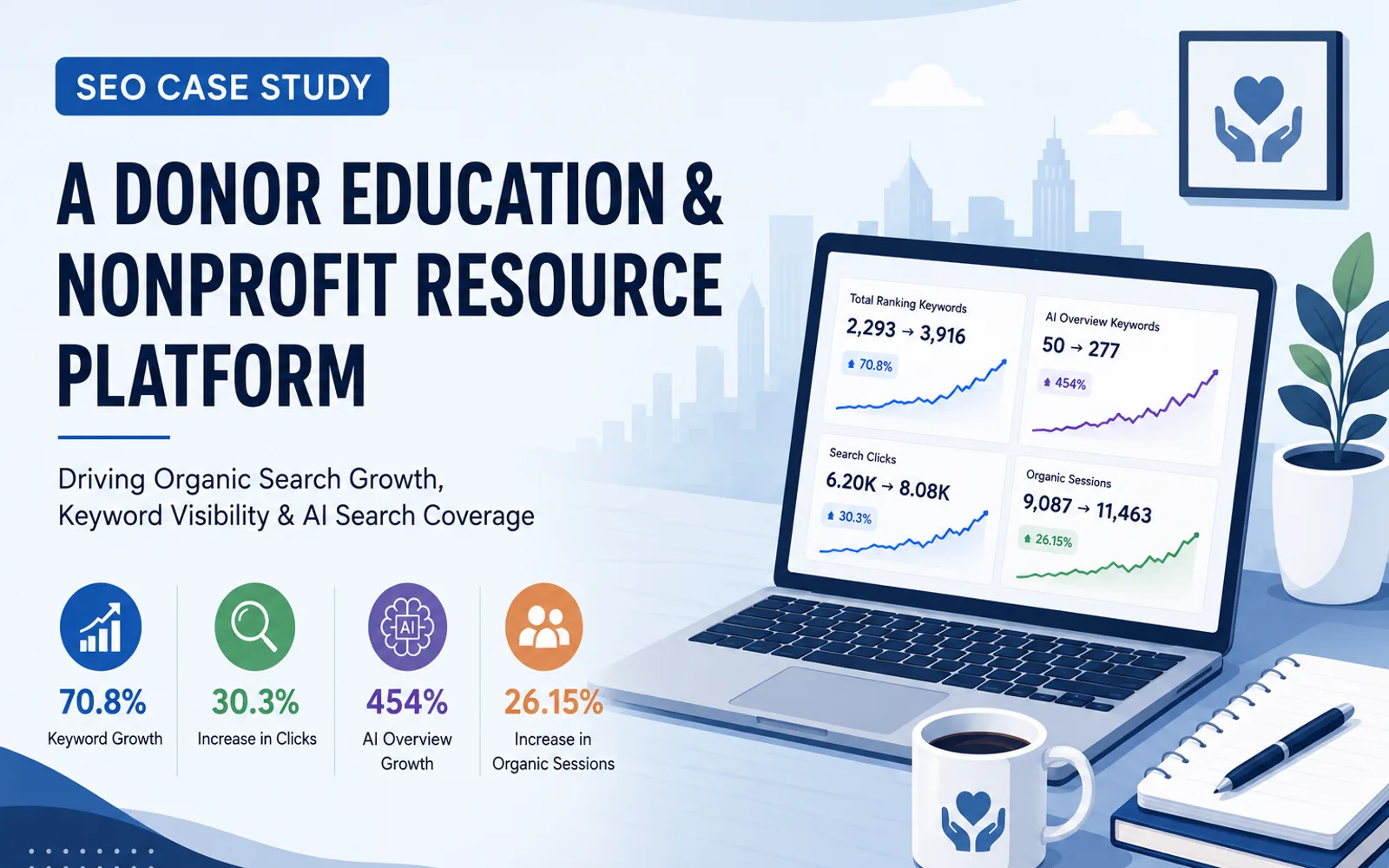
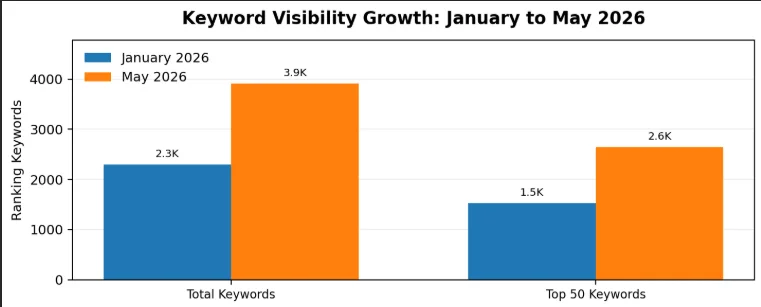
From January to May 2026, the total number of ranking keywords increased from 2,293 to 3,916, a 70.8% improvement.
Top 50 keyword coverage grew from 1,529 to 2,644, a 72.9% increase.
This showed that the website was becoming visible for a much wider set of relevant searches across donor education, foundations, planned giving, fundraising, and nonprofit-related topics.
Major Improvement in AI Overview Visibility
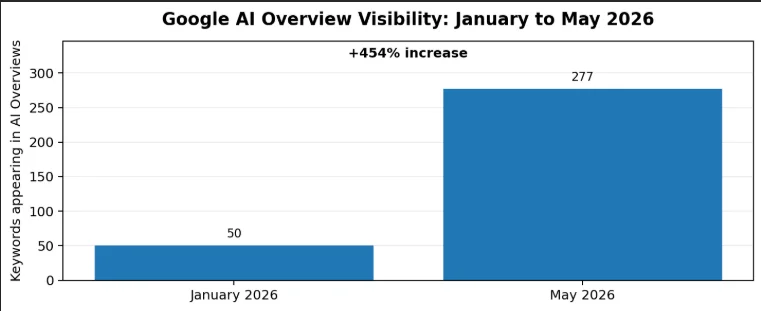
Keywords appearing in Google AI Overviews increased from 50 in January to 277 in May, a 454% improvement.
This was a strong signal that the website’s content was gaining wider visibility across answer-focused and AI-driven search experiences, in addition to traditional organic rankings.
Higher Google Search Clicks and Impressions
In the latest three-month Google Search Console comparison ending in May 2026:
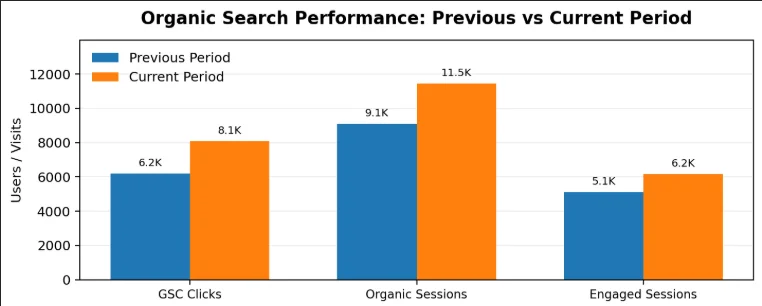
Clicks increased from 6.20K to 8.08K, a 30.3% improvement
Impressions increased from 1.60M to 1.86M, a 16.3% increase
Average position improved from 8.5 to 8.1
CTR remained stable at 0.4% despite the increase in search exposure
Growth in Organic Traffic and User Activity
Google Analytics data for March 1 to May 31, 2026, compared with the previous period, showed:
Organic sessions increased from 9,087 to 11,463, a 26.15% improvement
Engaged sessions increased from 5,120 to 6,176, up 20.63%
Event count increased from 43,320 to 53,294, up 23.02%
Average engagement time improved from 44 seconds to 49 seconds
These gains showed that search growth was also translating into stronger on-site engagement and user activity.
Strong Rankings for Important Tracked Terms
The May tracked-keyword report showed all 72 priority terms ranking in the Top 50.
Of those:
33 were ranking in the Top 3
51 were in the Top 10
65 were in the Top 20
Important terms holding position #1 included high-value informational and sector-related keywords tied to donor education, definitions, nonprofit resources, and related topics.
Meaningful Movement on Priority Keywords
Several priority keywords recorded strong upward movement during the reporting period.
Examples included:
a history-focused keyword moving from position 29 to 2
a consulting-related keyword moving from 19 to 5
a planned-gifts term improving from 30 to 12
a nonprofit executive search-related term improving from 74 to 20
These gains showed that the account was not only growing in broad visibility but also moving target terms into more competitive ranking positions.
Conclusion
The SEO work delivered clear positive movement across keyword coverage, Google Search visibility, organic sessions, user engagement, and AI Overview visibility.
The website increased its presence across a broader set of relevant topics while also improving rankings for important donor education, planned giving, foundation, nonprofit resource, and fundraising-related keywords.
The next phase should continue to focus on keywords already in positions 11–50, where targeted content refinement, stronger internal linking, title and meta updates, direct-answer sections, and FAQ coverage can deliver further gains in the Top 10 and the AI Overview.