
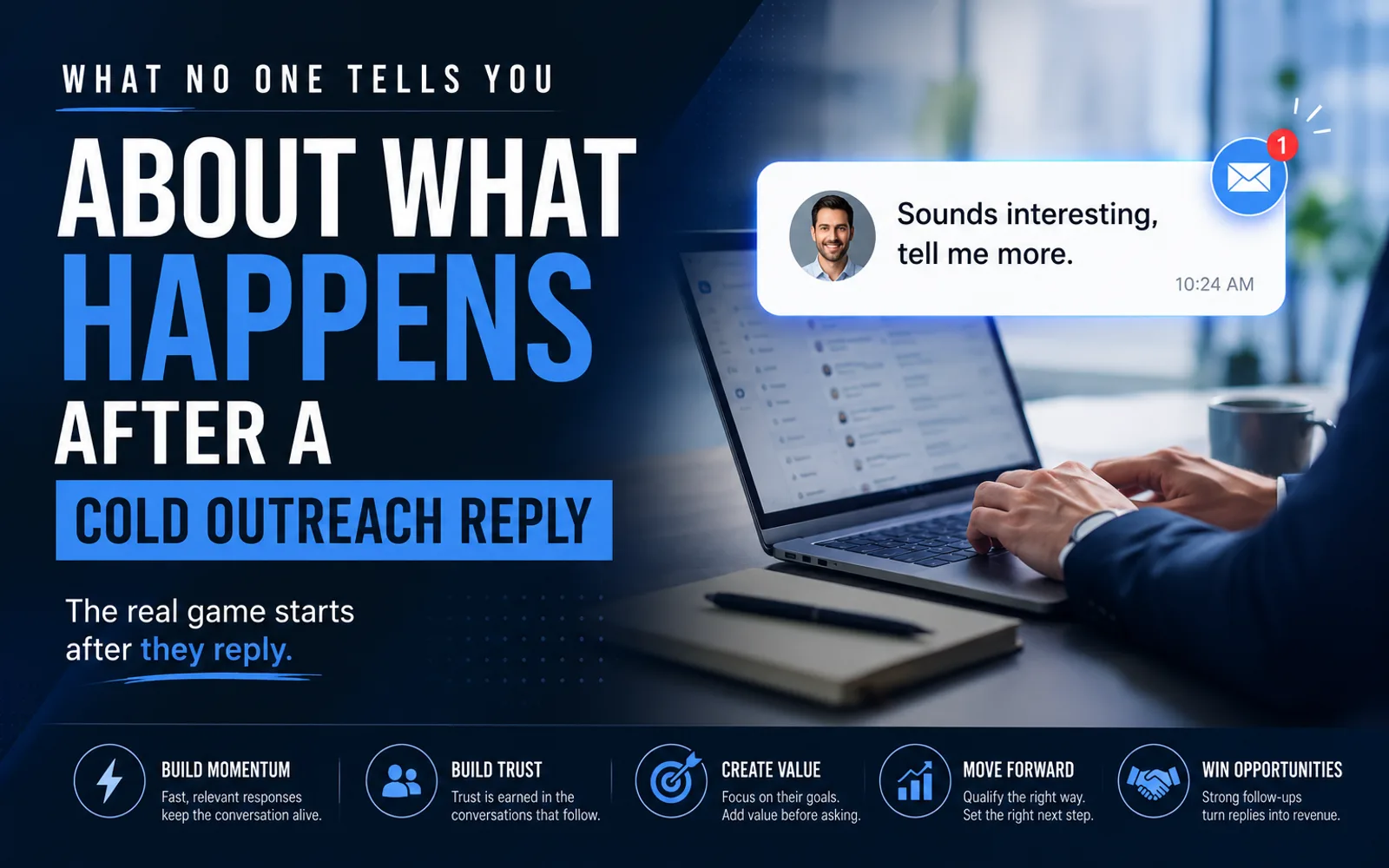
What No One Tells You About What Happens After a Cold Outreach Reply
Cold outreach gets all the attention.
People obsess over subject lines, personalization, open rates, and reply rates. LinkedIn is full of advice on how to get prospects to respond.
But almost nobody talks about what happens after someone replies.
And that’s exactly where most deals are lost.
Getting a reply is not the finish line. It’s the beginning of a much more important process. The real challenge starts the moment a prospect shows interest, curiosity, or even mild engagement.
This is the part no one tells you about.
Why Most Cold Outreach Fails After the Reply
Most outreach campaigns are optimized for one metric: replies.
But replies do not equal revenue.
A prospect replying with “Sounds interesting” or “Tell me more” feels exciting, but many businesses unknowingly destroy momentum immediately after that first interaction.
Here’s what usually happens:
The response takes too long
The follow-up feels robotic
The prospect gets hit with a generic sales pitch
The conversation suddenly becomes transactional
There is no clear next step
The outreach loses context and relevance
The prospect replied because something caught their attention. But if the next interaction feels disconnected, trust disappears quickly.
The reality is simple:
Cold outreach is not about getting replies. It is about building momentum after the reply.
The Psychology Behind a Positive Outreach Reply
When someone replies to a cold message, they are not “ready to buy.”
They are simply open to continuing the conversation.
That’s a huge difference.
At this stage, prospects are subconsciously evaluating:
Does this person understand my business?
Is this another automated sales sequence?
Will this waste my time?
Is there actual value here?
Can I trust this person?
Your next message determines whether the conversation grows or dies.
Most people assume the hardest part is getting attention. In reality, the hardest part is sustaining relevance after attention is earned.
What Successful Outreach Teams Do Differently
High-performing outreach teams treat replies differently.
Instead of rushing into a demo request or pitching services immediately, they focus on conversation progression.
Here’s what that looks like.
1. They Respond Fast
Speed matters more than most people realize.
A delayed response kills emotional momentum. If a prospect replies and hears back 24 hours later, the energy of the interaction fades.
Fast responses create the feeling of attentiveness and professionalism.
Even a short acknowledgment can keep momentum alive.
Example:
“Appreciate the reply, John. I had a look at your recent expansion into enterprise accounts and I think there may actually be an interesting fit here.”
That feels human.
2. They Avoid Over-Selling Too Early
One of the biggest mistakes after a reply is immediately sending a long company pitch.
Prospects do not want a brochure.
They want relevance.
The best follow-ups continue the conversation naturally by focusing on the prospect’s situation, goals, bottlenecks, or opportunities.
Instead of:
“We are a full-service agency offering AI-powered solutions…”
Try:
“Curious, are you currently handling this internally or working with external partners?”
That keeps the dialogue open.
3. They Build Context Before Asking for a Call
A meeting should feel like the natural next step, not the immediate objective.
Strong outreach conversations create enough context that the prospect begins seeing the value themselves.
This is where thoughtful questioning matters.
Good questions:
Reveal pain points
Surface priorities
Build trust
Create positioning naturally
Bad questions feel scripted and self-serving.
The Hidden Stage Nobody Talks About: Reply Qualification
Not every reply is valuable.
And that’s okay.
Some replies are curiosity-driven.
Some are polite.
Some are objections.
Some are genuine buying signals.
The key is understanding the difference.
Types of Cold Outreach Replies
Positive Intent Replies
Examples:
“Interesting, tell me more.”
“How does this work?”
“Can you share examples?”
These indicate curiosity and possible alignment.
Passive Replies
Examples:
“Not right now.”
“Maybe later.”
“Send details.”
These require nurturing, not aggressive follow-ups.
Defensive Replies
Examples:
“We already have a provider.”
“Not interested.”
These are not always dead ends. Sometimes they simply mean your positioning was weak or your timing was off.
The best outreach professionals know how to continue conversations without sounding desperate.
Why Generic Follow-Ups Kill Deals
Most cold outreach follow-ups sound identical.
That is the problem.
Prospects can instantly recognize templated responses because they lack specificity.
Generic follow-up:
“Just checking if you saw my previous message.”
Better follow-up:
“I noticed your team recently expanded into healthcare accounts. That’s actually where we’ve seen response rates improve significantly with more personalized outbound workflows.”
Specificity creates credibility.
And credibility creates conversations.
The Real Goal of Outreach Is Not Meetings
This may sound controversial, but the goal of cold outreach is not actually meetings.
It is trust.
Meetings are simply a byproduct of enough trust being built.
When outreach is treated purely as a numbers game, conversations feel mechanical.
But when outreach focuses on relevance, timing, and understanding the prospect’s world, conversion rates improve naturally.
That is why smaller, well-researched campaigns often outperform massive automated blasts.
What Happens Internally After a Prospect Replies
This is another overlooked reality.
When a prospect replies positively, internal evaluation often begins immediately.
Your message may get forwarded internally.
Your company website may get reviewed.
Your LinkedIn profile may get checked.
Your case studies may get scanned.
Your credibility may get silently evaluated before you even know it.
That means your brand presence matters far more than most outreach experts admit.
If your outreach feels strong but your online presence looks weak, inconsistent, or generic, trust collapses.
Cold outreach does not operate in isolation anymore.
Every touchpoint matters.
The Importance of Multi-Touch Credibility
Modern buyers validate before they commit.
After replying, prospects often check:
Your LinkedIn presence
Your website
Client proof
Testimonials
Industry expertise
Content quality
This is why outreach and branding should never be separated.
A strong outreach strategy supported by authority-building content dramatically increases conversion quality.
Why Timing Changes Everything
A common misconception is that cold outreach success depends entirely on messaging.
Timing plays an equally important role.
Sometimes prospects reply simply because:
A budget opened up
A previous vendor failed
Internal priorities shifted
Leadership changed
Growth pressure increased
This is why persistence matters.
Many successful deals come from conversations that started months earlier.
The Best Outreach Conversations Feel Natural
The highest-performing outreach does not feel like outreach.
It feels like:
A relevant conversation
A timely insight
A useful observation
A meaningful business discussion
The moment conversations become overly scripted, trust drops.
People buy from people who understand context.
Not people who sound automated.
Common Mistakes Businesses Make After Getting Replies
Here are the biggest post-reply mistakes businesses make:
Talking Too Much About Themselves
Prospects care about outcomes, not company descriptions.
Sending Calendars Too Early
Trying to force meetings immediately often creates resistance.
Ignoring Personalization After the First Message
Many teams personalize the first outreach but completely stop afterward.
Using Automated Sequences Mid-Conversation
Nothing destroys trust faster than robotic replies after human engagement begins.
Failing to Research the Prospect Further
Once someone replies, deeper research should begin immediately.
How to Handle Cold Outreach Replies More Effectively
If you want better conversion rates from outreach, focus on these principles:
Stay Conversational
Avoid sounding overly polished or corporate.
Be Context-Aware
Reference relevant industry changes, growth signals, or operational challenges.
Add Value Before Asking
Insights outperform pitches.
Keep Momentum Alive
Fast, thoughtful replies matter.
Focus on Fit, Not Volume
Not every reply needs to become a sale.
Final Thoughts
The biggest misconception in cold outreach is believing the hard part is getting replies.
It is not.
The real challenge begins after someone responds.
That is where trust is built.
That is where positioning matters.
That is where opportunities are won or lost.
Anyone can automate outbound messages.
Very few know how to manage the human side of conversations once engagement starts.
And in today’s market, that difference matters more than ever.
If your outreach strategy is focused only on reply rates, you are optimizing for the wrong metric.
Because the real game starts after the reply.