Key Takeaways
LinkedIn's algorithm rewards platform-resident behaviour: frequent posting, early engagement, active commenting
Most working professionals cannot compete with creators who treat LinkedIn as a full-time channel
LinkedIn visibility and professional capability are not the same thing
If your posts get low engagement, the problem may be the system, not your value
In This Article
Does LinkedIn Favour Creators Over Working Professionals?
Why LinkedIn Visibility Now Requires Full-Time Behaviour
What We See in Client Work
Why Most Working Professionals Cannot Play This Game Daily
This Is Not an Argument Against LinkedIn Creators
LinkedIn Visibility Is Not the Same as Professional Capability
The Leadership Engagement Dynamic Is Also Worth Naming
How to Use LinkedIn Without Letting It Use You
Frequently Asked Questions
Final Thought
This article is for working professionals who feel invisible on LinkedIn despite doing genuinely good work.
LinkedIn is useful. Let me say that first, because this article is not about discrediting LinkedIn.
We use LinkedIn for recruitment, lead generation, finding decision-makers, identifying candidates, understanding companies, building credibility, and reaching people we may not otherwise reach. At Think Big Digital, we advise clients on LinkedIn marketing. We help them think through content strategy, posting plans, visibility, outreach, positioning, and engagement.
So this is not an outsider's take. This comes from inside the game. And because we know the game, this needs to be said clearly.
LinkedIn visibility bias is real, even if LinkedIn never uses that term. It is the structural advantage that creators, consultants, and full-time content professionals hold over ordinary working professionals on the platform. The algorithm rewards posting frequency, early engagement, and real-time responsiveness. People who can dedicate two to four hours daily to LinkedIn consistently out-distribute equally skilled professionals who cannot. Visibility reflects time availability, not professional depth.
LinkedIn is useful. But LinkedIn visibility is slowly becoming a full-time behaviour system. And that system is not built for ordinary working professionals.
Does LinkedIn Favour Creators Over Working Professionals?
To be fair, LinkedIn may say it is only trying to make the feed more relevant and useful. That is understandable. A platform with over one billion members worldwide cannot show everything to everyone. It has to decide what to show, when to show it, and to whom.
So naturally, LinkedIn looks at relevance, professional interest, engagement signals, network behaviour, and dozens of other ranking factors. That is not wrong in itself. But the question is not only what LinkedIn intends. The question is what behaviour the system rewards in practice.
And in practice, LinkedIn rewards people who behave like creators. Post at the right time. Stay active after posting. Reply quickly. Comment on other people's posts. Build a network that responds. Keep appearing. Keep reacting. Keep proving that you are active.
LinkedIn may not be designed to disadvantage ordinary professionals. But its visibility system rewards people who can behave like full-time creators. That distinction matters.
Why LinkedIn Visibility Now Requires Full-Time Behaviour
People who study LinkedIn growth will tell you many things. Post on certain days. Post at certain times. Post consistently. Stay active in the first hour after publishing. Encourage comments. Reply properly. Do not just say "thanks." Comment on other people's posts before you publish your own. Build relationships before posting.
Some of this is grounded in how the algorithm works. Some is exaggerated. Some is not an official LinkedIn rule at all. But forget the exact formula for a moment. The bigger point is clear: LinkedIn visibility now requires sustained behaviour, not just insight.
The platform is not only asking, "Did this person write something useful?" It is also asking: "Is this person active? Are people responding? Is conversation happening? Does this person have a network that reacts? Is this content generating signals?"
That shifts the equation from insight to availability. And availability is exactly where ordinary working professionals lose.
According to a LinkedIn Engineering Blog paper on feed ranking signals published in October 2024, posts that gain engagement within the first hour receive significantly wider distribution than posts that sit quiet during that window. A Buffer analysis of over two million LinkedIn posts found that posting 2 to 5 times per week yields measurably more impressions and engagement per post compared to posting just once a week. Socialinsider's 2024 LinkedIn benchmarks report, covering millions of posts, confirmed that multi-image and carousel posts generate the highest engagement on the platform at 6.60%, while posts with no early interaction are deprioritised quickly regardless of content quality.
That is not a problem if you are a creator whose job is to be on LinkedIn. It is a real structural problem if you are an engineer, a finance professional, a field operations manager, or anyone else for whom LinkedIn is not the job.
What We See in Client Work
We see this directly when advising clients on LinkedIn marketing. The conversation is never just "write a good post." It covers topic consistency, timing, native content formats, document posts, dwell time, early engagement windows, meaningful comments, and how to stay active before and after publishing.
For clients, this makes sense because LinkedIn is a strategic business channel. They want leads, candidates, visibility, authority, or access to decision-makers. LinkedIn activity is planned, resourced, and tracked as part of a growth system.
That is exactly the point. This is planned work. It requires time, attention, and consistent discipline.
So when an ordinary working professional compares their LinkedIn visibility with someone using LinkedIn as a strategic business channel, that comparison is structurally unfair. One person is playing a casual weekend game. The other is running a professional operation with a playbook.
LinkedIn increasingly rewards platform residents: people who are present, active, responsive, and available. But most working professionals are not platform residents. They are employees, operators, engineers, recruiters, managers, salespeople, finance professionals, field people, and business owners with real work to finish before they even think about posting.
Why Most Working Professionals Cannot Play This Game Daily
A software engineer working on a production issue cannot stop mid-debug because the first hour of a LinkedIn post matters.
A finance professional closing month-end accounts cannot say, "Let me reply to comments because my post needs reach."
A field professional travelling between client meetings cannot sit and comment on ten people's posts.
A recruiter deep in a search process, a founder dealing with a cash flow problem, a delivery manager preventing a project failure. None of them can stop and perform on LinkedIn because the algorithm demands activity.
And in many organisations across India, LinkedIn activity is informally stratified by role. For HR, recruitment, sales, marketing, and leadership, LinkedIn activity is accepted as part of the job. But if an engineer, finance executive, analyst, admin person, or operations professional spends extended time on LinkedIn during office hours, it is rarely called personal branding. It is called timepass.
So what is that person supposed to do?
Work sincerely from 9 to 6, travel home, spend time with family, handle responsibilities that never stop accumulating, and then compete for LinkedIn visibility with people who were active on the platform all day?
Either you earn for your family, or you perform on LinkedIn every day.
That may sound harsh. But many working professionals will understand exactly what that means.
This Is Not an Argument Against LinkedIn Creators
Let me be direct here. This is not an attack on LinkedIn creators.
If someone is a creator, consultant, coach, trainer, recruiter, marketer, salesperson, founder, or content professional and LinkedIn helps them build their business, there is nothing wrong with that. For them, LinkedIn is the work. Posting is work. Engaging is work. Commenting is work. Building an audience is work. Staying visible is work.
That is their profession. Their business. Their revenue stream. Many creators work hard at it. Some write very well. Some educate people genuinely. Some create real value.
The problem is not that creators play the LinkedIn visibility game.
The problem starts when ordinary professionals compare themselves to people whose entire job is to play that game. That comparison is structurally unfair, and it causes people to feel inadequate for the wrong reasons.
A person checking LinkedIn after dinner cannot meaningfully compare themselves to someone who treats LinkedIn as a dedicated three-hour daily business channel. Different game. Different time. Different purpose.
LinkedIn Visibility Is Not the Same as Professional Capability
This part of the article is for working professionals specifically. Do not feel small because your post got twelve likes. Do not feel ignored because someone else got eight hundred reactions. Do not assume your career has a ceiling because you are not posting every day.
You may simply be busy doing real work.
Some of the strongest professionals have almost no LinkedIn visibility. A good engineer may quietly fix a critical production issue at 11 PM. LinkedIn does not see it. A field professional may save a client relationship through three hours of travel, a difficult conversation, and a committed follow-through. LinkedIn does not see it.
A recruiter may close a genuinely difficult position after forty calls and careful follow-up. LinkedIn does not see it unless someone turns it into a post. An operations manager may prevent a delivery failure that would have cost a client six figures. LinkedIn does not see it.
But someone can write a clean post at the right time, receive early engagement, reply quickly to every comment, and become visible. That does not make the visible person useless. It only means that visibility and professional value are two separate things.
Confusing LinkedIn visibility with professional capability is one of the more damaging things happening in professional culture right now.
The Leadership Engagement Dynamic Is Also Worth Naming
There is one more thing worth saying directly. Many leaders feel good when employees like and comment on their posts. Sometimes the appreciation is genuine. Sometimes the post adds real value. Sometimes the comment is thoughtful.
But not always.
Sometimes people engage because hierarchy exists. Sometimes they want to be seen. Sometimes they want to appear aligned. Sometimes it is just office politics, typed politely.
A like is not always admiration. A comment is not always conviction. Sometimes it is attendance. And sometimes it is the digital equivalent of nodding in a meeting you did not need to attend.
This is not an insult to leaders. It is a note that LinkedIn engagement metrics should not always be read as genuine influence signals.
How to Use LinkedIn Without Letting It Use You
Use LinkedIn. Use it to find decision-makers, connect with recruiters, identify candidates, build credibility in your domain, share genuine expertise, and create business opportunities. If lead generation or recruitment is part of your actual role, use LinkedIn seriously and strategically.
But do not blindly benchmark yourself against people playing LinkedIn as a full-time strategy. Do not compare your evening activity with someone whose workday runs on LinkedIn. Do not compare a simple post with someone who has a content calendar, an engagement pod, a hired writer, a follower base built over three years, or a business model that requires visibility.
And do not assume that the most visible person is always the most capable. Often, the most capable person is just busy.
Frequently Asked Questions
Why do my LinkedIn posts get no views?
LinkedIn's algorithm heavily weights engagement signals in the first hour after a post goes live. If you do not have a large, reactive network or cannot stay active during that window, your posts receive less distribution regardless of content quality. This is a structural platform issue, not a reflection of your professional value.
Does LinkedIn visibility reflect professional competence?
No. LinkedIn visibility reflects platform behaviour: how frequently you post, how fast you respond to comments, and how engaged your network is. Many highly competent professionals are invisible on LinkedIn because they are occupied doing actual work. The two are not the same.
How does the LinkedIn algorithm decide what content to amplify?
LinkedIn evaluates engagement rate in the first hour, network relevance, post format, dwell time, and comment quality. Posts that generate early interaction are amplified. Posts that receive no early signals are suppressed quickly, even if the content is valuable.
Should a working professional post on LinkedIn every day?
Not necessarily. Daily posting only makes sense if LinkedIn is a strategic business channel for you. For most working professionals, occasional quality posts are far more sustainable than forced daily content. Consistency matters, but not at the cost of your actual work.
Is there a LinkedIn bias towards creators over employees?
LinkedIn has not explicitly stated a creator preference. But the behaviour its algorithm rewards maps almost exactly to how creators work, not how most employees work. The visibility system structurally disadvantages ordinary working professionals, even if that is not LinkedIn's stated intent.
Final Thought
LinkedIn is useful. Creators are not wrong for using it. LinkedIn may not be intentionally unfair.
But the LinkedIn visibility game has become exhausting for ordinary working professionals. And the worst part is not the exhaustion. It is that people are starting to measure their professional worth by a metric that was never designed to measure it. Understanding LinkedIn visibility for what it actually is, a platform behaviour signal and not a measure of professional capability, is perhaps the most freeing thing a working professional can realise right now.
So if your post does not go viral, do not feel small. If you are not constantly visible, do not feel left behind. If you are not posting, commenting, replying, and performing every day, that does not mean you are not valuable.
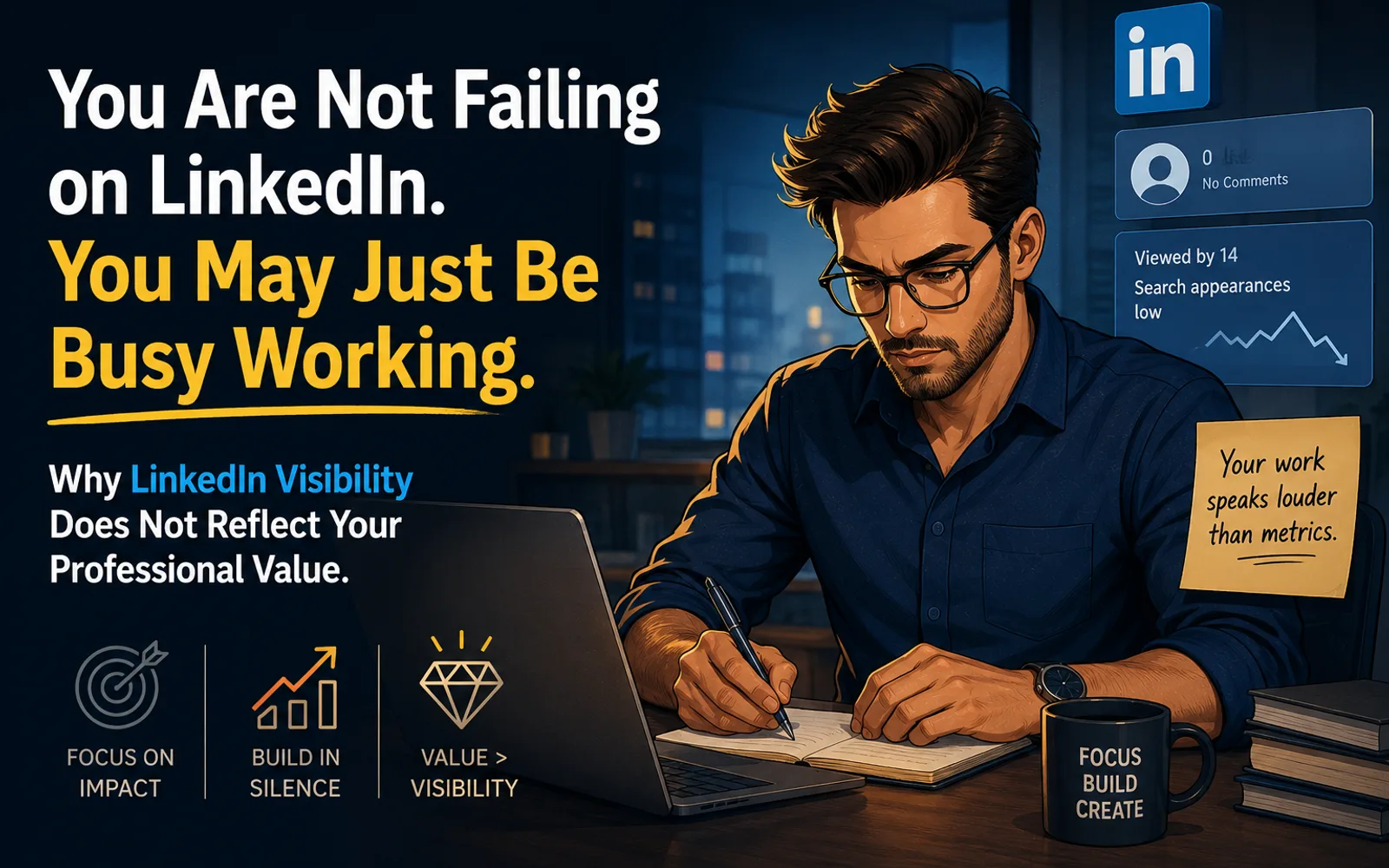
You are not failing on LinkedIn.
You may just be busy working.
Think Big Digital helps B2B companies build LinkedIn marketing systems, content strategies, and outbound pipelines that generate results. Updated 2026.