
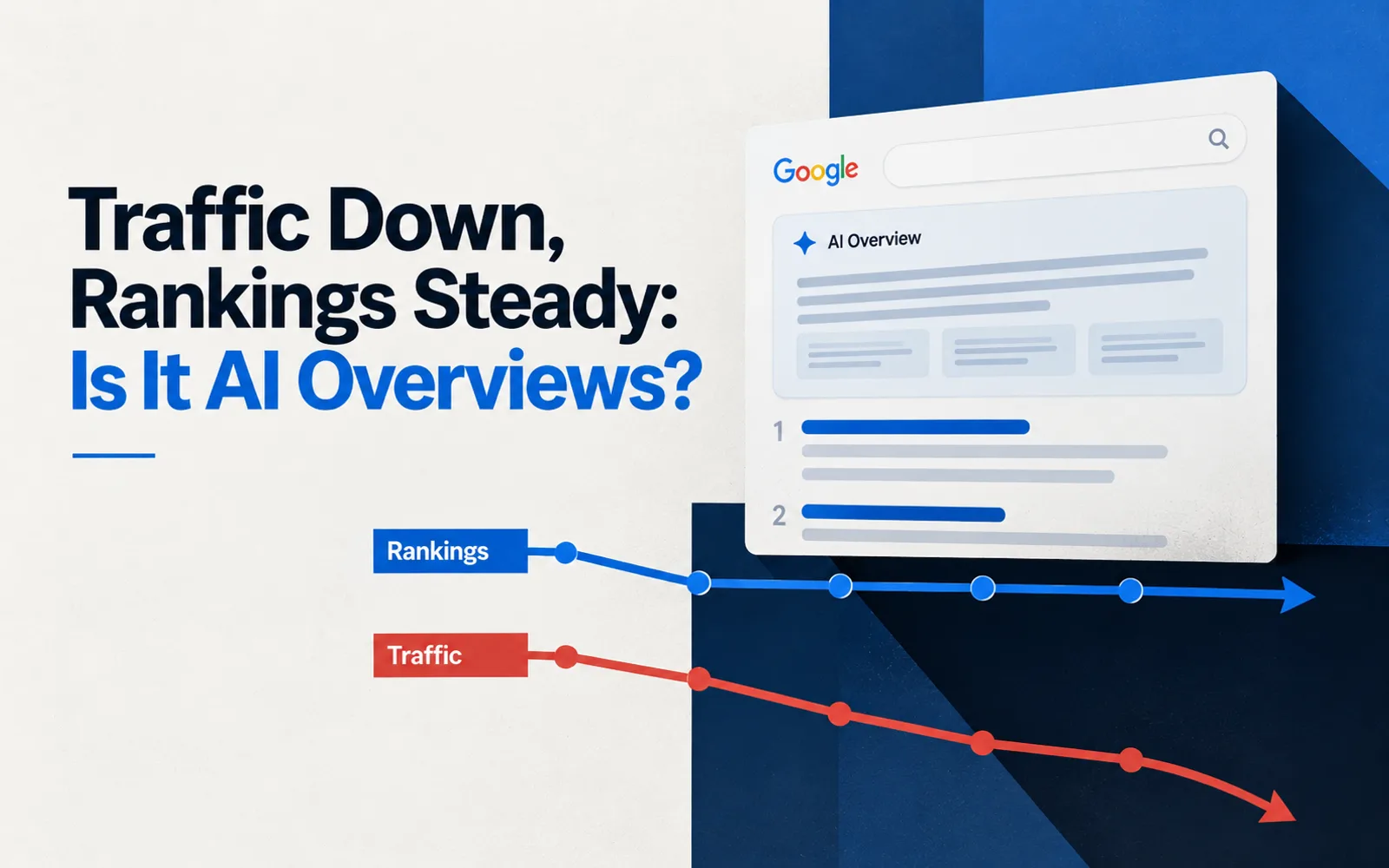
The monthly SEO report comes in. Your main service page still ranks in the top three, same as last quarter. Inquiries from Google are down anyway.
Traffic is down; rankings are the same. Someone on the call says what everyone is thinking: "It's AI Overviews."
It might be. It's also the most convenient answer in the room, because it's nobody's fault and nobody has to fix anything. That's exactly why it should be the last thing you conclude.
Quick answer: If your rankings held but clicks fell, AI Overviews is one of six common causes, and the only one you can't fix directly. Rule out a September 2025 reporting change, small position slips, seasonality, site changes and broken tracking first. Then compare Search Console's Generative AI report with clicks for the same pages, country by country.
Why is "it's AI" the wrong first guess?
Google publishes a guide to debugging traffic drops, last updated in December 2025. It covers the exact pattern you're looking at: impressions holding while clicks fall. Its explanation is that your page title and snippet may not be as good as they could be, or that competitors have a more appealing rich result.
AI Overviews isn't mentioned.
That doesn't mean AI Overviews isn't costing you clicks. On the searches where they appear, they do. It means the same chart has several possible causes. You need to know which one you're looking at before you spend money reacting to it.
What does the research actually show?
AI Overviews are the AI-written summaries Google shows above its regular search results, with links to the pages they draw from. Every rigorous study of how they affect clicks has so far used US users. That matters if your customers are in London, Dubai, or Sydney, so here's what's known and where the gaps are.
Three US studies, three methods, same direction:
Pew Research Center tracked the real browsing of 900 adults in March 2025, across 68,879 Google searches. With an AI summary on the page, people clicked a regular result on 8% of visits, against 15% without one.
Saharsh Agarwal (Indian School of Business) and Ananya Sen (Carnegie Mellon University) ran a randomized experiment in early 2026. A browser extension hid AI Overviews for some of the 1,065 participants, across 68,089 searches. When the overview was shown, outbound clicks to websites fell 39.8%.
Researchers at the University of Pennsylvania and Northeastern University ran a separate preregistered experiment with about 1,100 users. Hiding AI Overviews raised click-through to websites by 8.8 percentage points.
Both experiments are working papers, not yet peer-reviewed. Still, three different methods pointing the same way are hard to dismiss.
Outside the US, the data is thinner:
Google says AI Overviews are available in more than 200 countries and territories and in over 40 languages.
In the UK, the regulator Ofcom found about 30% of searches show an AI Overview, and 53% of adults say they often see these summaries.
France was one of the last major markets to get them. AI Overviews and AI Mode launched there on 22 July 2026.
We haven't found an independent click study for Canada, Australia, the UAE, or the wider EU.
So treat the US numbers as direction, not as your number. AI Overviews reduce clicks on the searches where they appear. How much they cost you in your markets is something only your Search Console can show you.
One more finding from Pew is worth keeping. In its US data, question-style and longer searches were far more likely to show a summary: only 8% of one- or two-word searches did, against 53% of searches with ten words or more. A service page ranking for a short term is much less likely to sit under a summary than a blog post answering "how long does X take".
Traffic down but rankings the same: what could cause it?
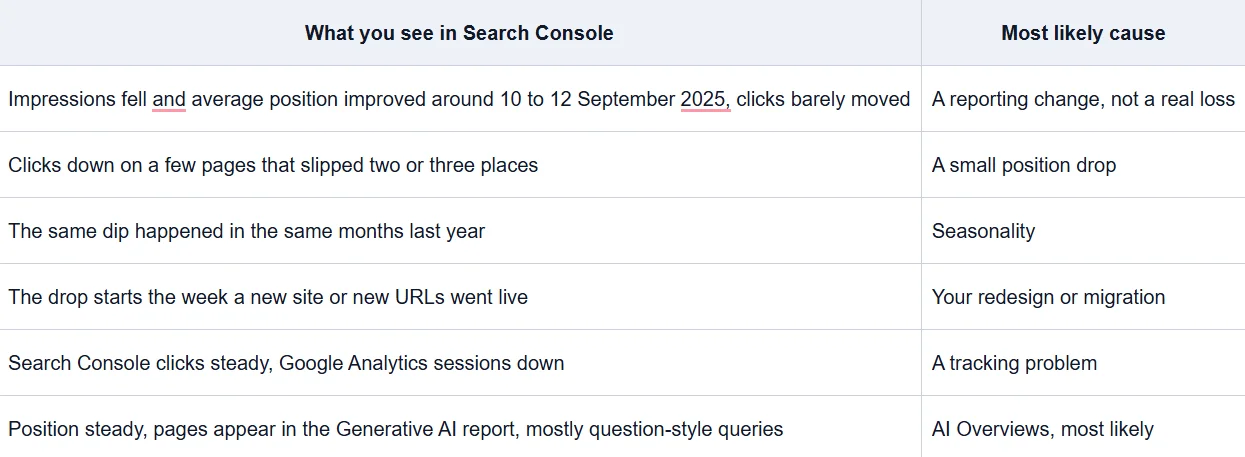
Six causes produce almost the same chart. This table tells them apart.
How do you check what caused your traffic drop?
You need Search Console access and, for one step, Google Analytics. Work through these four checks in order, and stop as soon as one explains the drop. Together they take about 30 minutes.
Check 1: Rule out the September 2025 reporting break (5 minutes)
In Search Console, open Performance, then Search results. Set the date range to the last 16 months and turn on all four metrics.
Now look at mid-September 2025. Around 10 September 2025, Google stopped supporting a search setting, the "&num=100" parameter, that rank-tracking tools used to load 100 results at once. Those automated loads had been counted as impressions. When they stopped, many sites saw impressions fall, and average position improve almost overnight.
If your drop lines up with that week and clicks held steady, nothing happened to your business. Your reports just got more accurate.
One trap: a year-over-year comparison made today still reaches back before that change. When a comparison crosses that date, trust clicks and ignore impressions.
Check 2: Find the pages and countries that lost clicks (12 minutes)
Click Compare and choose the last three months year over year. Open the Pages tab and sort by clicks difference. Note the five pages that lost the most.
For each one, check average position in both periods. Google's guide notes that a small slip, say from position 2 to 4, can cause a noticeable drop in traffic without much change in impressions. If that's what you see, you've found your answer, and it's one you can work on.
One wrinkle: in Search Console, an AI Overview occupies a position of its own. If one appears above your link, your position number can slip by one, even though no competitor moved.
Now split it by country. Keep the comparison on and open the Countries tab, then open the country view in the Generative AI report. If clicks fell mainly in countries where your pages also get AI impressions, that points to AI Overviews. If the drop is spread evenly across markets, including those with few AI impressions, look elsewhere. French traffic compared year over year now crosses the 22 July 2026 launch date, so keep that date in mind.
Check 3: Rule out seasonality, site changes and tracking (8 minutes)
Seasonality: Put the top queries for those pages into Google Trends. If interest fell across the web, the drop isn't about you. This is the check Google itself recommends.
Your own changes: Did the drop start when a redesign launched or URLs changed? That's a different problem with different fixes. See Website Redesign Mistakes That Cost You Leads (internal link)
Tracking: If Search Console clicks are steady but Google Analytics sessions fell, Google is still sending people. Something on your site stopped counting them.
Check 4: Test for AI Overviews (5 minutes)
Open the Generative AI performance report (Search) in Search Console. Google added it on 3 June 2026 and says it reached all websites worldwide on 31 August 2026.
Check whether the pages from check 2 appear there with impressions. Then go back to the main report, filter to one of those pages, and open the Queries tab. Are the queries questions, or long and specific?
If position held, the pages show AI impressions, the queries look like questions, and checks 1 to 3 came up empty, AI Overviews is the most likely explanation.
Notice that's "most likely", not "proven". Search Console can't give you more than that yet.
What can Search Console tell you about AI Overviews?
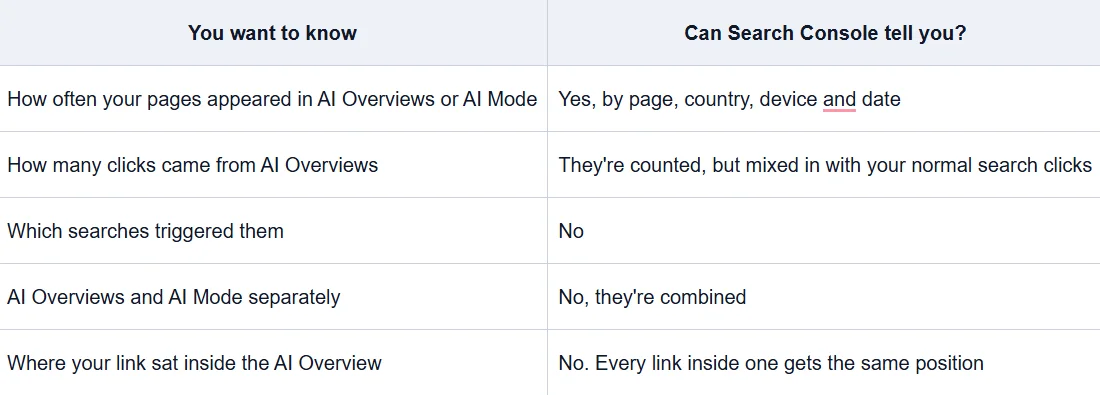
Search Console gives you part of the picture. Here's which part.
What should you do if it really is AI Overviews?
Leave the opt-out switch alone for now. Search Console now includes a setting to remove your site from Google's AI features. Google says sites that opt out "will not receive traffic or impressions from our generative AI features." Without click data, you'd be switching off something you can't measure.
Skip the hacks. Google's own guide to AI search says that, for Google Search, you can ignore llms.txt files, splitting content into small chunks, and rewriting pages just for AI systems. From Google's side, optimizing for AI search is, in its words, "still SEO".
Give people a reason to click. A summary can answer "how long does X take?" It can't hand over your calculator, your checklist, or your own numbers. Google's guide points the same direction: favor a unique viewpoint and firsthand experience over a rewrite of what's already out there.
Judge SEO by leads, not sessions. If organic inquiries held while traffic fell, the visits you lost may have been people who only wanted a quick answer. Your CRM can tell you that; Search Console can't. See Fake, Invalid or Just Unqualified? A Lead Quality Guide (internal link)
How do you explain the drop to your boss?
Copy and adapt:
"Our rankings are stable. Clicks are down on [pages], mostly on question-style searches where Google now shows an AI answer, and mainly in [countries]. We've ruled out a reporting change, seasonality, site changes and tracking. Organic leads are [up / flat / down]. Here's what we're changing on those pages."
It's specific, and it doesn't pin the drop on anyone.
FAQ
Does Search Console show clicks from AI Overviews?
Yes, but not separately. Google counts a click on a link inside an AI Overview as a normal click, so those clicks are already in your Search results numbers. The Generative AI report shows impressions only, so you can't isolate AI clicks in Search Console today.
Does this apply outside the US?
Yes, though the hard numbers are mostly American. AI Overviews run in more than 200 countries, and UK regulator Ofcom found them on about 30% of UK searches in 2025. The click studies so far used US users, so check your own Search Console, split by country, to see the effect in your markets.
Why did my impressions drop while my average position improved in September 2025?
Around 10 September 2025, Google stopped supporting the &num=100 search parameter that rank trackers used to load 100 results at once. Those automated loads had been counted as impressions. When they disappeared, impressions fell, and average position rose for many sites, with no change in real visitors.
Can I see which searches triggered an AI Overview for my site?
Not in Search Console. The Generative AI report breaks impressions down by page, country, device, and date, with no query list. The closest you can get is filtering the main report to a page that shows AI impressions and reading which queries it ranks for.
Should I block my site from AI Overviews?
Not without data. Google says opting out removes your traffic and impressions from its generative AI features, and Search Console doesn't yet show how many clicks those features send you. Run the check above first, and decide once you know what you'd be giving up.
Does falling traffic mean my SEO has stopped working?
Not necessarily. If rankings held and the drop sits on question-style pages, fewer people may need to click. Check whether organic inquiries fell too. If leads held, the searches that bring you business are probably still working.
Before you react
A good ranking used to be a fair stand-in for traffic. It isn't always now, and that gap is where expensive mistakes get made, like a panicked redesign or a canceled SEO budget.
Run the check. It takes half an hour and tells you which problem you actually have.
If you'd rather go through it with someone, we run this check as part of our SEO audits. Talk to us