Sales says your leads are bad. Marketing says volume is up. Run this 30-minute lead quality audit to find out which of the four problems you actually have.
Key takeaways
Lead quality is not one problem. It is four, and they need four different fixes.
A fake lead has no buyer behind it. An invalid lead has a real buyer and unusable contact details. An unqualified lead is a real person at the wrong kind of company. A low-intent lead is the right person at the wrong time.
Most teams assume they have a fake lead problem. Sort 30 days of submissions into those four buckets, and you usually find something else.
Automated traffic accounted for 53% of all observed internet traffic in 2025, with bad bots making up 40%, according to the Thales 2026 Bad Bot Report. That is the pool your forms are collecting from.
The argument that never gets settled
The meeting goes the same way every quarter. Marketing puts up a slide showing lead volume climbing. Sales says the leads are garbage. Both sides have a spreadsheet. Neither spreadsheet is wrong.
The reason the argument never resolves is that the two teams are counting different objects and calling them the same word. Marketing counts form submissions. Sales counts people worth phoning twice. The gap between those two numbers is where your budget quietly goes to die, and nobody owns it because nobody has named it.
So before you change your targeting, rewrite your ads, or blame your SDRs, you need to answer a narrower question. When sales says the leads are bad, bad in which way?
There are four answers, and they have almost nothing in common.
Most of the internet is not a person anymore
Start with the thing nobody put in the marketing report.
The Thales 2026 Bad Bot Report, now in its thirteenth annual edition and based on full-year 2025 activity analyzed by Thales Threat Research and Security Analyst Services teams, found that automated traffic accounted for 53% of all observed internet traffic in 2025. Bad bots made up 40% of that, with benign automation accounting for the remaining 13%. Human traffic has fallen to 47%.
Two other numbers from the same report matter if you run forms. Bad bot traffic rose from 37% the previous year, the seventh consecutive year of growth. And AI-driven bot activity increased more than tenfold in 2025, with daily blocked requests rising from 2 million to 25 million.
The geographic split matters too if you sell into North America. The United States remains the most targeted country, accounting for 59% of bot attacks.
None of this means half your leads are fake. It means the assumption underneath your lead reporting — that a form submission implies a person stopped being safe some time ago. Worth checking rather than assuming.
Four problems that look identical in a spreadsheet
Here is the part most lead quality advice skips. In your CRM, all four of these render as one row with a name and an email address. They are not the same problem and they do not share a fix.
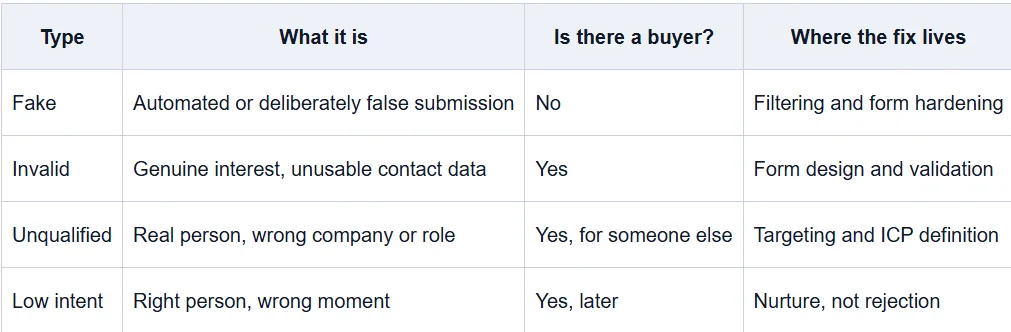
A fake lead has nobody behind it. Bot submissions, competitor snooping, a test entry someone forgot to delete, a form filled with plausible-looking nonsense. No amount of follow-up produces a conversation because there is nothing there to have one with.
An invalid lead is the frustrating one, because a real person wanted to talk to you and you cannot reach them. A typo in the email. A phone number missing a digit. A personal Gmail address when your sales process is built around company domains. The intent was real. The record is unusable.
An unqualified lead is a real person having a real look at your website who is never going to buy, because they are a student, a job seeker, a competitor, a supplier, or a business one tenth of your minimum deal size. Nothing wrong with the lead. Wrong fit for you.
A low-intent lead is the one teams throw away by mistake. Right company, right seniority, genuine curiosity, no budget cycle open for another eight months. Sales calls them twice, gets nowhere, and marks them dead. They were not dead. They were early.
Fix the wrong one and you will make things worse. Tighten your forms to stop fake submissions when your actual problem is unqualified traffic, and you will lose good leads while the bad ones keep coming.
The lead reality check
This takes about 30 minutes and needs nothing you do not already have. Export your last 30 days of form submissions to a spreadsheet, add a column called Type, and work down the list.
Step one. Mark the fakes. Look for submissions completed in under two seconds, gibberish in the name or message field, duplicate submissions from one IP, and email addresses at domains that do not resolve. If your form has no timestamp data, check whether anyone ever replied to these people and whether those replies bounced.
Step two. Mark the invalid ones. Attempt contact if you have not already. Hard-bounced emails, disconnected numbers, and records where the company field is blank or nonsense go here. The test is not whether they wanted to talk to you. It is whether you could reach them if you tried.
Step three. Mark the unqualified ones. Compare each remaining record against your ideal customer profile. Wrong industry, wrong company size, wrong country, wrong job function, or a personal email with no company attached. Be honest here. This is the bucket teams inflate to protect their targeting.
Step four. Everything left is either qualified or early. Split it one more time. Did they ask a question that implies a live project, a deadline or a budget? That is intent. Did they download something and go quiet? That is early.
Step five. Convert to percentages. Five numbers, adding to 100. That is your lead quality profile, and it is worth more than any industry benchmark you will find online.
On which point, a word of warning. We went looking for reliable public benchmarks for this and mostly found vendors citing other vendors. Figures for the same funnel metric vary by more than thirty percentage points depending on who is selling what. The most defensible outside number we found comes from First Page Sage, whose own published benchmark data puts the average lead-to-MQL conversion rate across industries at 31%. Use it as a rough sanity check, not a target. Your own five numbers are the real data.
Reading your split
The dominant bucket tells you which department has the problem.
If fake dominates, this is a website and infrastructure job, not a marketing one. Add a honeypot field, add a minimum time-to-submit threshold, and put a bot filter in front of the form. Avoid solving it with a harder captcha, which taxes your genuine buyers to inconvenience software that is very good at captchas.
If invalid dominates, look at your form before you look at your traffic. Long forms, mandatory fields people resent, no inline validation on email and phone, and mobile layouts that swallow a character. These are the same design decisions that quietly cost you leads after a redesign. This is usually the cheapest problem on the list to fix and the one most likely to be sitting in plain sight.
If unqualified dominates, your targeting is working exactly as instructed and the instructions are wrong. The offer is attracting the wrong reader, or the channel is pointed at the wrong audience, or your ideal customer profile exists as a slide rather than as a filter anyone applies.
If low intent dominates, congratulations, your marketing is working and your follow-up is not. These people are real and they are yours to lose. They need a nurture sequence, not a rejection code.
If nothing dominates and you have a smear across all four, the problem is that no definition of a lead exists in your business. Agree one, in writing, between marketing and sales, before touching anything else.
Why bad leads get more expensive over time
There is a compounding effect here that catches people out, and it lives inside your ad account.
If your Google Ads conversion tracking stops at the form submission, that is the event the system optimises toward. It will find more people who submit forms, at the lowest cost it can, because that is what you asked for. It has no way of knowing which of those submissions turned into a conversation.
Google's own documentation points the way out of this. Google Ads supports qualified lead and converted lead as goal types, letting you optimise toward deeper lead-to-sale funnel events and tag events by funnel stage. As Google puts it, this allows advertisers to accurately identify the most promising Google-generated leads using their offline conversion data, with the lead funnel report showing conversion volumes across interactions, leads, qualified leads and converted leads.
In plain terms: feed the outcome back. Send the platform your real qualification results rather than your form fills, and it optimises for the leads that turn into revenue.
Until you do that, every bad lead is not just a wasted call. It is a training example teaching your ad spend to go and find more like it.
The same principle applies inside the business. Bad leads inflate pipeline value, which distorts the forecast, which sets the wrong targets, which shapes next quarter's budget. And once sales stops trusting marketing's leads, response times slip on all of them, including the good ones. That is the expensive part, and it does not show up in any report.
What to measure instead of lead count
Lead volume is a fine number to know and a terrible number to manage by. Replace it with a short chain, measured monthly:
Submissions received
Valid submissions (a real person you can reach)
Qualified submissions (a real person who matches your ICP)
Accepted by sales (someone agreed to work it)
Opportunities created
Customers won
The drop between any two adjacent steps tells you where to spend your next hour. A steep fall from one to two is a website problem. A steep fall from two to three is a targeting problem. A steep fall from three to four is an alignment problem, and it usually means marketing and sales are still using two different definitions of the word lead.
Track it per channel, not just in aggregate. A channel with a high cost per lead and a clean conversion chain is often cheaper than a channel producing bargain leads that never survive step three.
Questions people ask about lead quality
What is lead quality?
Lead quality measures how likely an incoming enquiry is to become a paying customer. It combines four things: whether a real person submitted it, whether their contact details work, whether their company matches your ideal customer profile, and whether they have a live buying need.
What is the difference between a fake lead and an unqualified lead?
A fake lead has no genuine person behind it, typically an automated submission or deliberately false data. An unqualified lead is a real person with real details who does not match your ideal customer profile. Fake leads need filtering. Unqualified leads need better targeting.
How do I know if bots are submitting my forms?
Check submissions completed in under two seconds, repeated entries from a single IP address, nonsense text in free-form fields, and email domains that fail to resolve. A honeypot field, a hidden input that humans never see and automated scripts often fill, catches a large share of them without adding friction for real visitors.
Is a low conversion rate always a lead quality problem?
No. A low conversion rate can come from slow follow-up, a weak sales process, or the wrong offer, all with perfectly good leads. Run the lead reality check first. If most of your leads are real, reachable and well matched, the problem sits after the handover, not before it.
Should we reject low-intent leads?
No. A low-intent lead is the right person at the wrong moment, and rejecting them wastes the hardest part of the work, which is getting a real reply from the right person. Move them to a nurture track with a review date rather than marking them dead.
Where this leaves you
The uncomfortable finding, most of the time, is that the lead quality problem is not really a lead quality problem. It is a definition problem wearing a lead quality costume. Two teams, two meanings of one word, and a set of reports that quietly measures the wrong object.
Run the reality check on 30 days of submissions. You will end up with five numbers, and those five numbers will tell you whether to fix your forms, your targeting, your follow-up or your reporting. Any of those is a smaller job than the one you were bracing for.
If the split points at your website and how leads are captured, routed and tracked, that is the part we work on. Send us your five numbers and we will tell you what we would change first.