Key takeaways
Published per-lead figures for B2B lead research range from $31 to $650 depending on industry, and the same industry is priced three different ways across three sources.
Two different products are being priced under one search. Contact data is billed per record. Qualified opportunities are billed per lead. The gap between them is roughly 100x.
Most circulating per-record figures are labelled as illustrative by the people publishing them, in text that readers skip.
No published benchmark can price your project, because the cost depends on how hard your specific contacts are to find.
Five questions will get a real number out of any vendor in one conversation.
This is for anyone who has been asked to budget for lead research or a lead list and has found that every source gives a different answer.
How much does B2B lead research cost?
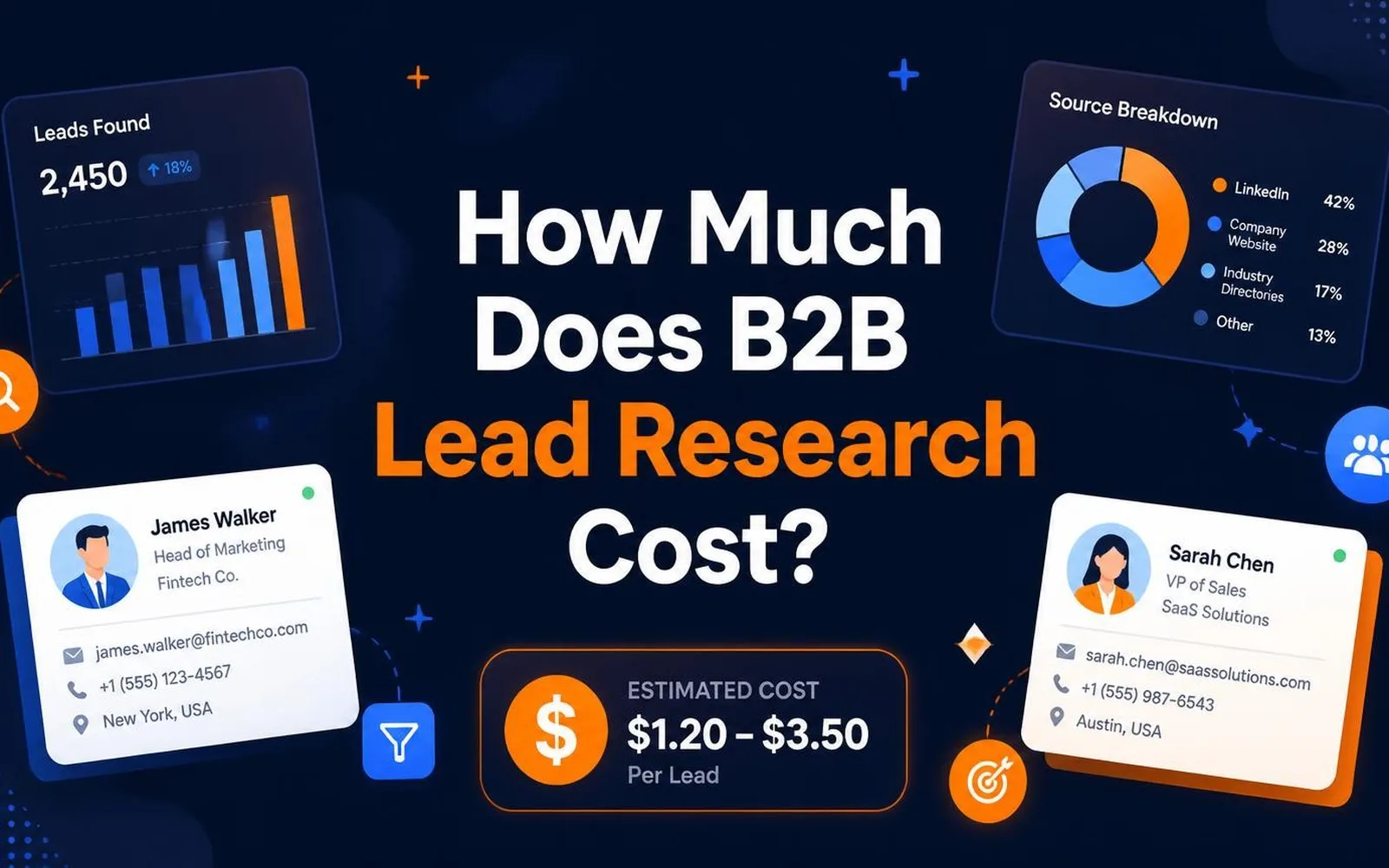
Published figures put B2B cost per lead between $31 and $650, depending on industry. WebFX reports $31 for non-profits, $132 for business services and $208 for technology. Sopro reports $650 for legal services, $595 for software development and $188 for B2B SaaS.
Those are per-lead prices, and a lead is an outcome. Raw contact data is a different product billed differently, usually per record, and the published figures are in cents rather than dollars.
So the first thing to settle is which one you are buying. If someone quotes you $400 and someone else quotes you 40 cents, they are probably both being reasonable about different things.
Why published prices disagree
We spent an afternoon tracing these numbers, and the surprise was not that they disagree. It was how many of them are labelled as guesses by the people publishing them, in the paragraphs most readers skip.
Here is the same industry, priced four ways:
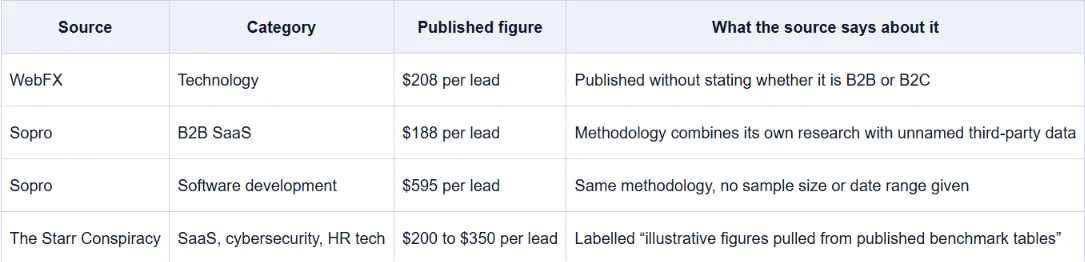
Four published figures for broadly the same buyer, from $188 to $595.
The per-record side is thinner still. Instantly’s pricing guide quotes $0.10 to $2.50 per contact and labels that range illustrative. Its $0.10 to $0.50 credit-based range and $0.02 to $0.10 budget tier carry no source. The only figure on the page with any attribution is a $15,000 to $40,000 annual enterprise band, credited to “reported contract values from buyers and third-party review sites,” which you can't check.
Sopro’s methodology section says the company “conducted proprietary research for the State of Prospecting 2025 report,” then that the benchmarks “have been compiled with data from other sources to form a complete collection.” It does not say which figure came from where. Its blended cost per lead also moves from $482.67 in 2023 to $481.56 in 2024/25, a 0.23% change, which is flatter than real measured data tends to be.
The Starr Conspiracy is the exception worth crediting. It names the benchmark tables it borrowed from, points out that they “rarely disclose” what counts as a lead, and says of its own audit numbers: “We are reporting what we see, not a universal benchmark.” That is what honest sourcing reads like.
None of this means the figures are worthless. Use them to sanity-check a quote. Don't use them as a target, and don't let a vendor use one as a justification.
Four ways lead research gets billed
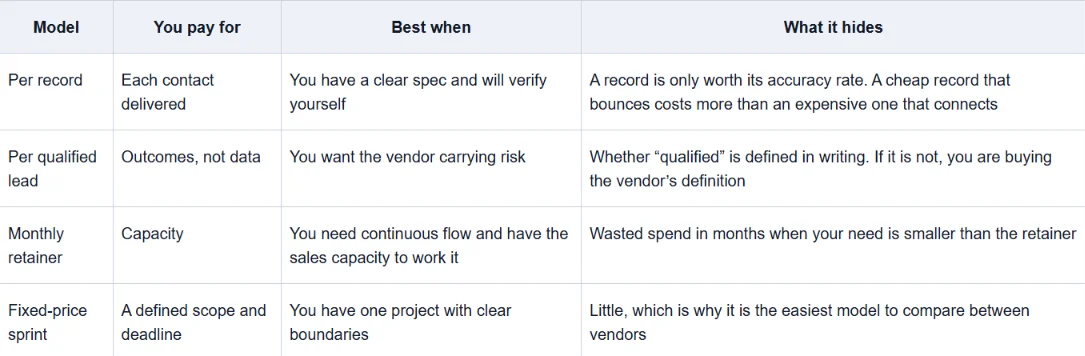
The per-qualified-lead model is where most disputes start, because “qualified” is doing a lot of work in that sentence. The four things a bad lead can actually be aren't interchangeable, and a contract that doesn't distinguish them will be read in the vendor’s favour.
What actually moves your price
The single biggest factor is how obscure your contacts are. A marketing director at a 500-person software company already sits in every database. An operations manager at a family-owned manufacturer with no web presence has to be found manually, one at a time. The second costs several times the first, and no tool has changed that.
After that, it is the fields. Company name and domain are nearly free. A verified direct email is the main cost driver. A verified mobile number costs more again, and in several markets it carries legal constraints worth checking before you buy, not after.
Geography matters more than most quotes admit. Contact data in the US and UK is dense and cheap. The Gulf, non-English markets, and parts of Europe with strict privacy enforcement are thinner, slower and priced accordingly.
Volume helps, but less than vendors imply, because hard-to-find records don't get easier in bulk. The 50 contacts you actually want are the expensive ones whether you order 50 or 5,000.
Then there is freshness, which is where cheap lists come from. A list built last quarter and resold costs a fraction of one built this week for you. Ask which list you are being quoted, because contact data decays at a measurable rate and a cheap list is often just an old one.
Five questions that get you a real number
Any vendor who cannot answer these is quoting you a guess.
What is your verification method, and what accuracy rate do you guarantee? Not “we verify everything.” The actual method, and a number you can hold them to.
What happens to records that fail verification? Do you pay for them, get replacements, or get a refund? This one answer can move the real cost by a third.
Can I see an anonymised sample first? Twenty records from a segment like mine, with the fields I asked for. Anyone who has done this work has samples.
Is this list built for me, or resold? If it is resold, your competitors have it too.
What is the turnaround, and what happens if you miss it? A list that arrives six weeks late has missed the campaign it was built for.
Send those five to three vendors. The spread in the answers will tell you more than any benchmark table.
Questions people ask
How much does B2B lead research cost per contact?
Published figures run from about 2 cents to $2.50 per record, but nearly every number in that range is labelled illustrative by the vendor publishing it. The real driver is how obscure your target contacts are and which fields you need verified, so any quote given without that information is a guess.
Is it cheaper to buy a list or build one?
Buying costs less per record, and the list is usually resold, so your competitors may be working the same contacts. Building costs more and gives you something current and exclusive. For a small, high-value segment, building almost always wins. For broad volume, buying can be defensible.
Why do lead generation prices vary so much?
Because two different services share the name. Lead research delivers verified contact data, billed per record. Lead generation delivers qualified opportunities, which includes the outreach and qualification work that follows a reply. The second costs several times the first, and vendors quote them interchangeably.
Should I pay per lead or per month?
Pay per lead when “qualified” is defined in writing and you want the vendor carrying delivery risk. Pay monthly when you need continuous flow and have the sales capacity to work it. If your need is one defined project, a fixed-price sprint costs less than either.
Can I trust published cost-per-lead benchmarks?
Check the attribution before you use one. The most-cited per-record figures are explicitly labelled illustrative by their publishers, and the industry tables often combine unnamed sources without stating sample size or date range. Use them to sanity-check a quote, never as a target.
What to do with this?
The honest answer to what lead research costs is that published prices range from $31 to $650 per lead and 2 cents to $2.50 per record, that the same industry gets priced three ways, and that none of it prices your project. What prices your project is how hard your specific contacts are to find.
You will notice we have not put our own rate card on this page. That is deliberate, and it would be strange not to explain it in an article about published guesses. We cannot quote you a number without knowing which contacts you need, in which markets, and which fields you want verified. Anything we published here would be the same kind of illustrative figure we just spent 1,000 words telling you to distrust.
What we can do is answer the five questions above about our own work, on a call, with a sample. Book a call and bring your target segment.